The Appraisal Institute defines “highest and best use” as “the reasonably probable and legal use of vacant land or an improved property that is physically possible, appropriately supported, financially feasible, and that results in the highest value.” (Appraisal Institute, The Dictionary of Real Estate Appraisal, 2022).
In Ohio eminent domain cases, the oft-cited and well-established standard for valuation of real estate comes from Sowers v. Shaffer, where the Ohio Supreme Court stated that land appropriation proceedings should value land not for any particular use, or even the current use, but instead:
[I]n accord with the most valuable uses to which the property could reasonably and practically be put.
Ohio R.C. 163.09 directs that it is within the purview of the jury to determine the value of the property taken, based upon the evidence presented.
With this background in mind, let’s turn to the question presented: Is it appropriate under Ohio eminent domain law to consider a land use development where that land use is expressly prohibited by current governmental land use restrictions?
The answer: YES. It would be short-sighted and improper to not, at the very least, consider the possibility that a governmental land use restriction could be modified. Note, the process discussed in the case study, below, was legislative and required approval, although there are often several paths. A highest and best use analysis requires a deep understanding of how the government can restrict land, and the legislative and adjudicative ways in which that restriction can be modified, a fact-specific endeavor.
The Property
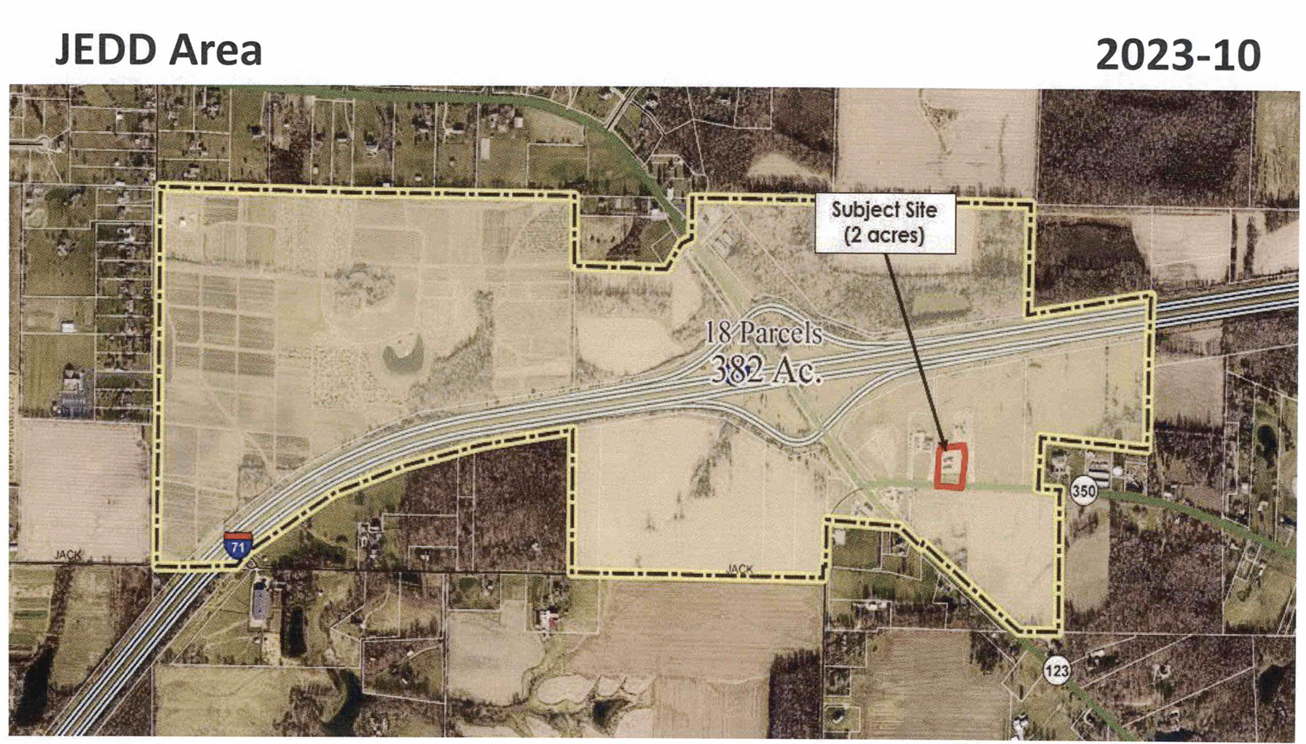
Let’s get into the case highlighting this point, Case 2023-10 before the Board of County Commissioners of Warren County, Ohio. This rezoning was a multi-phase process before numerous administrative bodies. Minutes from the final hearing are available here.

The property at issue was vacant, undeveloped land that was part of Warren County, Ohio’s Interstate 71 and State Route 123 Joint Economic Development District (JEDD) Overlay.
When I was hired to petition to rezone the property, nearly ten years had passed since the enactment of the JEDD. In this time, the land lay fallow. In fact, the entirety of the 382-acre JEDD was largely vacant during this time (more on this later).
The property abutted a major fuel station, and I was retained when a prominent national automobile service provider approached the property owner to develop a light mechanical and tire repair facility to support semi-trucks.
In addition to providing semi-truck maintenance, this provider would also travel 60 miles to help repair semi-trucks broken down on the highway, making the highway safer for everyone. The adjacent fuel station also offered to provide certain necessary infrastructure for the service provider. It is difficult to imagine a better use for the property, given the harmony between the proposed uses.
Alas, the property owner faced a barrier to development: per the JEDD, the desired use was completely off the table. Prohibited uses included the following: Automobile Oil Change, Lube, Light Service; Automobile Body Repair Shop; Automobile General Repair; Truck Terminals. Thus, this highly compatible, highly appropriate proposed use was expressly prohibited.
But this story did not end with a NO. We did some digging, including through planning documents. These documents indicated that water and sewer were “a critical element of the 71/123 Area Plan,” and outlined a proposal for future development of this critical infrastructure as part of the JEDD development.
Fast forward seven years, and while the JEDD became effective, the planned infrastructure did not. The anticipated costs for infrastructure exceeded estimates to the tune of millions, which happens. All development in the area was stalled.
On behalf of the property owner, I petitioned the Warren County, Ohio Board of County Commissioners to rezone the property, and remove it from the JEDD Overlay which so expressly prohibited the proposed use. After a multi-step hearing process, as well as meetings with Regional Planning Commission Staff, the Warren County Commissioners voted to “Approve” the rezoning and JEDD removal. Finally, the property could be developed.
Eminent Domain Takeaways
What’s the moral of the story here? Every property is different, and every zoning jurisdiction is different. With that said, governmental zoning designations are not all immutable. Government plans can grow and change, like all of us.
At the end of the day, should a “Highest and Best Use” analysis in eminent domain consider the possibility of future development, notwithstanding governmental land use prohibitions to the contrary? Absolutely. If the property highlighted here was taken by eminent domain prior to the rezoning, a draconian approach to zoning restrictions could have resulted in an improperly depressed valuation.
And while the focus of this article is Ohio eminent domain, the facts and principles of this specific matter could be instructive elsewhere. Ohio is a proud part of the midwest, and abuts the northern-most southern state, Kentucky, where I grew up and also practice eminent domain law. Ohio is also the birthplace of the mother of zoning decisions, the United States Supreme Court decision of Village of Euclid v. Ambler Realty Co., 272 U.S. 365 (1926).
Holley Law represents property owners of developable land in eminent domain matters, both in Ohio and Kentucky. Learn about the other types of properties Holley Law can assist here.
Good luck to everyone seeking to preserve the right to just and fair compensation. If you had an eminent domain case where you were able to establish a nuanced highest and best use, I would love to hear it. You can reach me at sh@holleylaw.com.